What Makes a Plastic “Machinable?
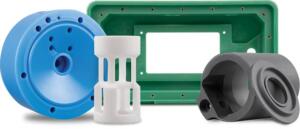
Not all polymers are suitable for the workshop. The category of machinable plastic materials encompasses a wide range of thermosets and thermoplastics that are stable enough to withstand the friction, heat, and shear forces of a CNC mill or lathe.
To determine if a material is right for your project, you must evaluate both its behavior on the machine and its performance in the field:
- Thermal Stability: Will the friction of the cutting tool melt the plastic?
- Dimensional Stability: Will the material warp or “creep” after it is removed from the fixture?
- Impact Strength: Can the material withstand the physical stress of its final application?
- Chemical Resistance: Will the part degrade when exposed to oils, coolants, or acids in its working environment?
Plastic Material Breakdown
Determining which machinable plastic fits your needs depends entirely on the environment the final part will inhabit. Below is a detailed breakdown of the 12 most common materials used in precision machining.
Delrin is widely considered the best plastic for machining for general-purpose precision parts. It bridges the gap between metals and plastics, offering high stiffness and low friction. It is a “free-cutting” material, meaning it produces clean chips rather than continuous stringy strands, resulting in a superior surface finish.
- Key Properties: Low moisture absorption, high stiffness, excellent dimensional stability.
- Common Applications: Gears, bushings, electrical insulators, stiffeners.
- Machining Tip: Be aware of “centerline porosity” in thick slabs of Delrin, which can allow gas leakage in pressurized applications.
Nylon is a legendary engineering plastic known for its incredible toughness and wear resistance. It is often used to replace metal bearings and gears because it is self-lubricating and creates less noise during operation.
- Key Properties: High tensile strength, high impact resistance, self-lubricating.
- Common Applications: Wear pads, rollers, manifolds, bearings.
- Machining Tip: Nylon is hygroscopic (absorbs moisture). Parts machined to tight tolerances may expand if used in humid or wet environments.
HDPE is a cost-effective, moisture-resistant material often used in food processing and chemical handling. While it is softer and more pliable than Delrin, making it slightly harder to hold tight tolerances, it offers excellent impact resistance.
- Key Properties: High chemical resistance, zero moisture absorption, low coefficient of friction.
- Common Applications: Cutting boards, chemical tanks, chute liners, food processing components.
- Machining Tip: HDPE is slippery and can be difficult to clamp. Vacuum fixtures or soft jaws are often recommended.
FR-4 is a thermoset laminate consisting of continuous filament glass cloth material with an epoxy resin binder. It is the global standard for electrical insulation and printed circuit boards.
- Key Properties: Extremely high dielectric strength, flame resistant (self-extinguishing), zero water absorption.
- Common Applications: PCB boards, electrical insulators, and terminal boards.
- Machining Tip: The glass content in FR-4 is extremely abrasive. Carbide or diamond-coated tools are required to prevent rapid tool wear.
Similar to FR-4 but lacking the flame-retardant additives, G-10 is a high-pressure fiberglass laminate. It provides extremely high mechanical strength and dimensional stability over a wide temperature range.
- Key Properties: Higher mechanical strength than FR-4, excellent electrical insulation, and chemical resistance.
- Common Applications: Structural supports, high-voltage insulators, aerospace components.
- Machining Tip: Like FR-4, G-10 produces abrasive dust during machining. Proper ventilation and respiratory protection for operators are essential.
When performance cannot be compromised, PEEK is often the top choice. It is a high-performance thermoplastic that retains its mechanical properties at very high temperatures (up to 480°F). It is chemical-resistant and often used as a lightweight replacement for metal in aerospace and medical components.
- Key Properties: Exceptional thermal stability, resistance to hydrolysis (steam), varying grades (glass/carbon-filled) available.
- Common Applications: Aircraft components, medical implants, semiconductor machinery parts.
- Machining Tip: PEEK is expensive. Ensure your setup is rigid, and speeds are calculated correctly to avoid scraping high-value material.
Lexan is renowned for its impact strength—it is virtually unbreakable. It is optically clear, making it the top choice for transparent structural components and safety guards.
- Key Properties: Optical clarity, high impact resistance (250x stronger than glass), good heat resistance.
- Common Applications: Machine guards, sight glasses, bullet-resistant windows, and lenses.
- Machining Tip: Polycarbonate is sensitive to stress cracking. Avoid using coolants that are not compatible with plastics, as they can cause “crazing” (micro-cracks) over time.
PTFE offers the lowest coefficient of friction of any solid material and outstanding chemical resistance. It is heat-resistant but relatively soft, making it susceptible to deformation under load (“cold flow”).
- Key Properties: Extreme chemical inertness, high temperature resistance (500°F), non-stick surface.
- Common Applications: Gaskets, seals, valve components, and non-stick guides.
- Machining Tip: Because it is so soft, PTFE is difficult to machine to very tight tolerances. Use very sharp tools and avoid excessive clamping pressure.
Udel is a high-strength, semi-tough, and transparent (amber-tinted) plastic that offers higher heat resistance than polycarbonate and acrylic. It is resistant to oxidation and hydrolysis, making it suitable for medical devices that require repeated sterilization.
- Key Properties: Hydrolytic stability (can withstand steam sterilization), transparency, and high strength.
- Common Applications: Medical device components, food service trays, and filtration membranes.
- Machining Tip: Annealing (heat treating) the material before machining can help reduce internal stresses and prevent cracking during production.
UHMWPE is an abrasion-resistant powerhouse. It is slick, tough, and resistant to corrosive chemicals. It excels in applications where parts slide against each other.
- Key Properties: Extreme abrasion resistance, self-lubricating, zero moisture absorption.
- Common Applications: Star wheels, conveyor guides, chute liners, dock bumpers.
- Machining Tip: Like PTFE, UHMWPE can be difficult to hold. It produces long, stringy chips that can wrap around the cutter, so chip clearing is vital.
Acrylic is the go-to plastic for milling when optical clarity is the priority. It machines well and can be polished to a glass-like transparency. It is brittle compared to polycarbonate but offers superior scratch resistance and UV stability.
- Key Properties: UV resistant (does not yellow), high optical clarity, easy to bond/glue.
- Common Applications: Signage, light pipes, lenses, display cases.
- Machining Tip: Cast acrylic is generally preferred over extruded acrylic for machining, as it is less likely to melt and gum up the tool.
Ultem is a semi-transparent, high-strength plastic that resists high temperatures and broad chemical exposure. It is often chosen for its excellent dielectric strength.
- Key Properties: High dielectric strength, flame resistance, high heat resistance (continuous use up to 340°F).
- Common Applications: Electrical connectors, aircraft interiors, reusable medical devices.
- Machining Tip: Ultem can be abrasive to tooling. Carbide tools are recommended to maintain surface finish quality.
Tips for Successfully Machining Plastics
Control Heat Generation
The biggest enemy of plastic machining is heat. Unlike metal, plastic does not conduct heat away from the cutting zone efficiently. If heat builds up, the part will expand, causing you to cut too much material. When the part cools, it will be undersized.
- Solution: Use sharp, high-positive rake tools to reduce friction. Use air blasts or plastic-safe coolants to keep the workpiece cool.
Select the Right Tooling
Standard metal-cutting end mills often have too many flutes for plastic. A high flute count leaves little room for chip evacuation.
- Solution: Use single-flute or two-flute end mills designed specifically for milling plastics. These allow for rapid chip evacuation, preventing heat buildup and re-cutting of chips.