
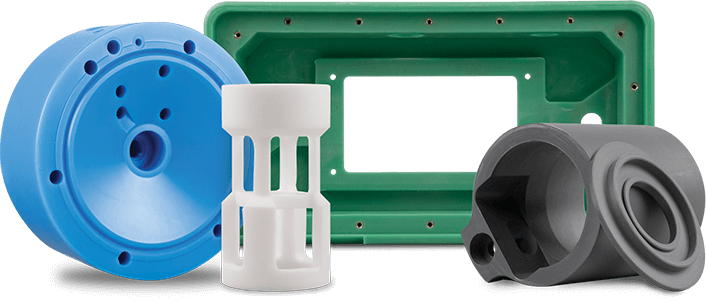
thermoplastic materials

We CNC machine the parts that others ‘No Quote’. Simple to complex, precision machining.

Thermoplastic Molding | Thermoplastic materials

A Leader in Thermoplastic Supply Companies

Searching for thermoplastic molding companies? We offer a full range of thermoplastic molding and machining services. Please click on the material below for product details and specifications.

Acrylonitrile-Butadiene-Styrene

ABS resins offer variable melt flow rates, impact resistance, tensile strength, and thermal stability to accommodate both high- and low-gloss injection molding applications. The material features solid mechanical performance, chlorine resistance, and a heat deflection temperature of up to 210°F.

Acetal Copolymer

Acetal Copolymers are crystalline thermoplastics with a lower melt point than nylon. The product has excellent dimensional stability, high strength, and stiffness and is impact and crash-resistant. (Elongation at break is approximately 40 percent). Acetal Copolymers are easy to machine, resistant to most chemicals except in acidic conditions, and offer low moisture absorbency, making the product a good choice for use in high moisture environments. Applications include Gears & Pulleys, Valve Fittings, Bearings, Electrical Components, and Anti-Friction Parts. The polymer has superior, which gives it high impact and crush resistance.

Polymethylmethacrylate

Acrylic is a thermoplastic polymer coating used for various applications including aircraft glazing, plumbing, eyewear, and lamination over ABS sheet to provide UV protection. Control of physical properties is achieved through the choice of alcohol used to make the ester. Methyl esters give harder films than butyl esters. Acrylic offers clarity, UV resistance, abrasion resistance, hardness, and stiffness. low water absorption low smoke emission. It is not recommended for use with temperatures above 120° Fahrenheit,

Cast Nylon

Cast Nylon is produced by the polymerization of molten, lactarn monomer directly into a hot mold with the addition of an activator and co-catalyst. Cast Nylon characteristics include high strength and good wear and abrasion resistance. Cast Nylon is a good choice for the production of sheaves, wear pads, and gears. It is also useful where wear, noise, and lubrication are an issue.

Delrin® Homopolymer

Delrin® has excellent dimensional stability, machinability, and high mechanical strength and stiffness. As a strong Polymer, Delrin® provides good wear and abrasion resistance, a low coefficient of friction, and low moisture absorption, making the product a good choice for use in high moisture environments. Delrin® is an excellent choice for its long term mechanical stability in applications such as Valves, Washers, Gears, Bushings, Bearings, Seals, Rollers, Timing Screws, Electrical Components, and Anti-Friction Parts. It is important to note that although Delrin® is strong mechanically, and offers excellent resistance to moisture, gasoline, solvents, and many other neutral chemicals, it cannot tolerate acidic conditions long term.

Delrin® Glass Filled ACETAL (Delrin®) Homopolymer

Delrin® Glass Filled provides the same basic properties as Delrin®, with added strength. Delrin® Glass Filled is a tough material that provides the added advantages of greater stiffness, improved creep resistance, low warpage, and higher dimensional stability than Delrin® because it possesses surface characteristics of Teflon®. Parts designed using glass-filled will demonstrate good impact resistance, low deformation under load, and high fatigue endurance. Delrin® Glass Filled is an excellent choice for its long-term mechanical stability in applications such as Anti-Friction Parts, Application Bearings, Gears, and Parts requiring greater stiffness, Electrical Components, and other Close Tolerance Precision Parts and Fuel System Parts.

High Density Polyethylene

HPDE resin is useful for applications that require toughness, rigidity and strength, making it a good choice for blow molding and injection molding applications. For blow molding applications, HDPE resins offer stiffness and stress crack resistance, which makes it a useful application for personal care, household and industrial containers. HDPE pipe resin offers toughness and stress crack resistance making it a good choice for pipe extrusion. HDPE resin offers strength and processability that is essential for injection molding applications.

Low Density Polyethylene

LDPE resin is easy to process and improves product performance because it offers excellent printability, strength, tear-resistance, and elasticity, which makes it a cost-effective choice for a variety of film applications. It is useful for producing a variety of products including liners, bags, shrink and lamination films, extrusion coatings, caps and closures. It is durable enough to produce a variety of products such as power cables and toys.

Lexan® Polycarbonate

Lexan resin is a leading polycarbonate offering impact resistance, durability, heat and flame resistance, and many other properties. This thermoplastic provides high levels of mechanical, optical, electrical, and thermal properties. Lexan resin provides opportunities for innovative, cost-effective use in the production of business equipment, eyewear, healthcare components, and an assortment of other products.

Nylon 6/6, 6, 6/12

Nylon 6 and 6/6 are the most commonly used Nylon Grades. Chemical resistance and electrical properties are similar, and they have a high molecular weight, which provides maximum resistance to wear and impact applications. Nylon 6/6 is the hardest, and it has a significantly higher melting point and just a gradual decrease in tensile strength as temperatures increase. Nylons work with little or no lubrication, but lubrication will improve the life and load-carrying properties. Nylons are useful near food and textiles.

PEEK Victrex Polyetheretherketone

PEEK is a crystalline thermoplastic and is chemically resistant. The product operates in high temperatures and in a wide ph range, from 60 percent sulfuric acid to 40 percent sodium hydroxide. Chemical resistance includes organic solvents, and its ability to perform in water temperatures as high as 500 degrees Fahrenheit. Its high mechanical properties, low smoke emission and self-extinguishing characteristics make PEEK a good choice for many applications including automotive engine parts, aerospace components, compressor valve parts and bearings.

Polyethylene

Polyethylene resin is useful for applications that require chemical resistance, little or no moisture absorption and flexibility. Its use is limited to temperature applications below 200 degrees Fahrenheit, and it has the ability to carry light loads for a long period. Polyethylene products include machined valves and fittings for fluid handling systems, tanks and pumps and industrial products that require a thermoplastic with low or high density, linear low density or ultra low density, tie-layer resins or adhesive resins. Polyethylene satisfies demands for reduced weight, increased strength, fast processing and lower costs. Polyethylene meets the needs of many tough applications.

Polysulfone

Polysulfone resins offer exceptional value and high-performance. Properties include excellent thermal stability, high toughness and strength, good environmental stress cracking resistance, high heat deflection temperature to 345°Farenheit and combustion resistance. Additionally, the product is approved for food contact and potable water.

PTFE Polytetrafluoroethylene

PTFE, better known as Teflon®, is a vinyl polymer with a structure similar to polyethylene. PTFE is useful in making anything that needs to be slippery or non-stick. It is also useful in producing components that meet the challenge of many applications in diverse markets including the food industry, chemical handling valves, automotive industry and biotech and pharmaceutical research. The carpet industry uses PTFE to treat carpets and fabrics for stain resistance, and it is useful in medical applications for making artificial body parts. PTFE is stable, and it will not react with anything because it repels everything.

PVC Polyvinyl Chloride

PVC offers the most economical solution when first-rate physical properties, chemical resistance, and self-extinguishing properties are essential at continuous temperatures below 155° Fahrenheit. Rigid PVC is widely used in chemical plants because it is resistant to chemical substances, has mechanical strength, and is easy to machine.

Teflon® Vinyl Polymer

Teflon® is a vinyl polymer with a structure similar to polyethylene. It is useful in producing components that meet the challenge of many applications in diverse markets including the food contact “CODEX”, chemical handling valves, automotive industry, and biotech/pharmaceutical research. It is useful in making anything that needs to be slippery or non-stick. The carpet industry uses PTFE to treat carpets and fabrics for stain resistance, and it is useful in medical applications for making artificial body parts. Teflon® is stable, and it will not react with anything because it repels everything.

UDEL Polysulfone

UDEL resins are a strong, rigid thermoplastic that maintains its properties over a wide temperature range and has a heat deflection temperature of 343° Fahrenheit. It offers exceptional value and high-performance and is an excellent choice for many fluid handling applications. Various grades are available for injection molding of complex parts, blow molding, and extrusion. Transparent, opaque, and glass-fiber reinforced grades of UDEL resin are available to meet the needs of many industries including medical and plumbing applications.

UHMWPE Poly Hi Solider

UHMWPE is a superior lining material useful for bulk material handling applications. It is abrasion, chemical, and corrosion resistant does not absorb moisture and has a low coefficient of friction thus promoting a reliable, steady bulk material flow. It is useful in steel mills, power plants, and many applications in the transportation industry.

Ultem® Polyetherimide

Ultem® offers excellent chemical resistance, high dielectric strength, natural flame resistance, and extremely low smoke generation. Its high mechanical properties and reputation for simplicity of fabrication and bonding, make it a good choice when high performance is required.

Talk to the Experts at Jaco

Our modern, well-maintained lineup of equipment and professional staff allows us to offer service second to none.  Give us a try on your next plastic project.

Plastic Properties Materials Guide

Material Description Application
FR4 FR4 is a versatile high-pressure thermoset plastic composite of glass fabric and epoxy resin. It is extremely stiff and strong and is used in mechanical applications where those properties are most important. FR4 is an excellent dielectric and is resistant to radiation and flame. With low—almost zero—moisture absorption and a high impact strength, FR4 is used in electrical equipment, test boards, and in the medical field.

  • Flame resistant
  • Radiation resistant
  • High dielectric rating 
  • High impact resistance
  • Circuit boards
  • Industrial wear applications
  • Electrical insulation
  • Screw terminal strips
  • Transformers
  • Arc shields
  • Washers
  • Busbars
  • Standoffs
  • Switches
  • Relays
UHMW Ultra-high molecular weight polyethylene (UHMW) is popular in industrial settings where durability and chemical resistance are key. UHMW is used as a bumper material for docks and as a liner for chutes and hoppers, and is suitable for the food processing industry. With a very low moisture uptake and good abrasion resistance, UHMW polyethylene is also easy to work with and fabricate.

  • Suitable for food processing and packaging
  • For tough environments
  • Wear strips
  • Chain guides 
  • Packaging machinery parts
  • Marine dock fender pads.
  • Conveyor line components
  • Bearings
  • Guide rails
  • Star wheels
  • Chute linings
  • Chemical tanks
  • Food processing parts
PEEK Polyetheretherketone (PEEK) is a strong, durable plastic that retains its hardness in even the harshest high-pressure and high-temperature environments. With very low moisture absorption and resistance to chemicals, this high-performing thermoplastic is a good choice for tough applications. PEEK is a high-performing material with superior strength across a wide range of temperatures and is used in aerospace and marine environments.

  • Suitable for food processing and packaging
  • For tough environments
  • Low moisture absorption
  • High dielectric rating
  • Resistant to extreme temperatures
  • Consumer electronics
  • Automobile
  • Medical
  • Aerospace
  • Semiconductors
  • Bearings
  • Piston parts
  • Pumps
  • HPLC columns,
  • Compressor plate valves
  • Cable insulation
  • Fluid management
  • Braided hoses
Teflon® Teflon® is a trade name of DuPont and refers to their non-toxic fluorocarbon-based polymer polytetrafluoroethylene (PTFE). Used widely in the food and beverage industry—yes, that’s the same Teflon that coats your frying pan—PTFE is highly resistant to heat, chemicals, and water. Teflon is also found in electronics due to its smoothness and its dielectric properties, and is popular in non-critical chemical, electrical, and mechanical components. You’ll also find Teflon in the construction industry, automotive industry, and the medical field.

  • Suitable for food processing and packaging
  • High dielectric rating
  • Food preparation
  • Waterproofing
  • Cosmetics
  • Paint finishing
  • Solar panels
  • Laboratory appliances
  • Anti-friction equipment
Nylon Nylon is an engineering thermoplastic used as a material for bearings and bushings, gears, wear parts, rollers, and gaskets. Nylon is a tough, stiff material with good thermal and chemical resistance. Its crystalline structure means it can absorb moisture from the surrounding environment. The amount of moisture it absorbs depends on the operating temperature. It has a high melting point (492.8 °F) and is less flammable than many other thermoplastics.

  • Suitable for food processing and packaging
  • For tough environments
  • Resistant to temperature extremes
  • Wear pads and strips
  • Switchgear
  • Seals
  • Wheels
  • Gloves and PPE
  • Instrument strings
  • Medical implants
  • Electrical connectors
  • Gears
Delrin® Delrin® is a high-performance acetal resin marketed by DuPont. It is a strong, stiff thermoplastic that is easy to machine, has a high impact rating, and high fatigue endurance. This makes it a suitable material for conveyor belts, gears, safety restraints, and other demanding applications. It takes color well, is highly water- and chemical-resistant, and is reliable in a wide range of hot and cold temperatures. It is considered the stiffest unreinforced engineering polymer available on the market.

  • Suitable for food processing and packaging
  • For tough environments
  • Resistant to temperature extremes
  • High-impact resistance
  • Pumps
  • Valves
  • Gears
  • Bushings
  • Rollers
  • Fittings
  • Electrical insulator parts
  • Sliding and guide parts
  • Rollers
  • Conveyors
Torlon® Torlon® is a high-performance thermoplastic with excellent insulation properties, a high dielectric strength, and reliability over a wide range of temperatures. These properties make Torlon a popular material for bearings, seal rings, electrical insulators, and sockets. It performs at temperatures up to 500 °F and is highly impact and compression-resistant.  This makes it an ideal choice for wear parts on critical machinery.

  • Suitable for food processing and packaging 
  • High dielectric rating
  • Resistant to temperature extremes
  • For tough environments
  • High impact resistance
  • Bearings
  • Gears and sprockets
  • Precision industrial parts
  • Bushings
  • Transmissions
  • Cams
  • Sliding parts
  • Seals
  • Valve seats
  • Wear rings
Ultem® Ultem® is a high-strength UV and temperature- and temperature-resistant material that has a high continuous use temperature rating of 340 °F. It is flame-retardant and low-smoke-generating, making it a logical choice for demanding, high-heat applications such as microwaves, medical components, and jet engines. Ultem is exceptionally resistant to environmental stresses and has a high dielectric strength.

  • Suitable for food processing and packaging
  • High dielectric rating
  • For tough environments
  • Resistant to temperature extremes
  • Food preparation and sterilization equipment
  • Eyeglasses
  • Circuit boards
  • Switches
  • Connectors
  • Electronic chips
  • Capacitors
  • Aircraft parts
  • Medical instrument components
  • Manifolds
  • Electrical connectors
  • Semiconductor components
ABS Acrylonitrile Butadiene Styrene (ABS) is a food-safe thermoplastic that is rigid and tough. With high impact resistance and insulation properties, ABS is also highly resistant to chemicals. It is a common material for pipe systems, and musical instruments and keyboard keycaps are often made from the material. Toys such as LEGO are made from ABS, as are canoes, pens, and many household and consumer goods. ABS has low chemical and dielectric resistance.

  • Suitable for food processing and packaging
  • High impact resistance
  • Food processing
  • Wall sockets
  • Consumer electronics
  • Power tool casings
  • Pipe systems
  • Musical instruments
  • Refrigeration
  • Machine prototyping
PVC Polyvinyl Chloride (PVC) is a very common thermoplastic polymer. It is naturally white and is a hard, strong material that is readily available—and very affordable. It resists impact deformation and is very resistant to chemicals and alkalis. There are some disadvantages, however. PVC has very poor heat stability, and it emits toxic fumes when melted or burned.

  • High impact resistance
  • Windows and doors
  • Drainage pipes
  • Medical devices
  • Cable and wire insulation
  • Flooring
  • Stationary
  • Packaging
  • Seat coverings and coated fabrics
  • Vehicle interiors and wiring
Polycarbonate Polycarbonate is a transparent thermoplastic with high impact and fracture resistance. It has an upper working temperature of 260°F and is a tough material that is very strong. Some versions of polycarbonate are FDA approved, making them suitable for food preparation and storage. It is easy to fabricate, has superior thermal insulation and UV protection properties, and is used in eyeglasses, medical devices, automotive parts, PPE, and exterior lighting fixtures. 

  • Suitable for food processing and packaging
  • Resistant to higher temperatures
  • High impact resistance
  • Transparent barriers
  • Medical devices
  • Automotive components
  • PPE
  • Greenhouses
  • Exterior lighting fixtures
  • Roofing and skylights
  • UV protection
Vespel® Vespel® is a trade name of DuPont and refers to their high-performing and lightweight plastic that is used in unforgiving industrial operating environments. Able to withstand extremely low and high temperatures, Vespel is commonly used for wear parts and bushings, bearings, and insulators. It is easy to fabricate with, costs less to manufacture than ceramic, and works particularly well in tough environments with high radiation, low or high temperatures, and environments where it is exposed to flames.

  • For tough environments
  • Resistant to temperature extremes
  • Lightweight/high load
  • Does not melt
  • Potable water tanks
  • Bearings
  • Bushings
  • Insulators
  • Washers
  • Wear parts
  • Glass handling
  • Chemical and water pumps
  • Compressors
  • Seals
Acetal Polyoxymethylene, or Acetal, is a high-performance engineering polymer that is strong, rigid, and tough, with excellent impact resistance. It is highly resistant to water, has good dielectric properties, and is easily fabricated and machined. Its strength and durability make Acetal a popular choice for plumbing parts, medical devices, bearings, and mechanical gears and valves. It is also an appropriate choice for food processing and food preparation.

  • Suitable for food processing and packaging
  • High dielectric rating
  • For tough environments
  • High impact resistance
  • Food processing
  • Bearings
  • Bushings
  • Manifolds
  • Gears
  • Jigs
  • Wear parts
  • Electrical components
  • Plumbing fixtures
  • Medical devices
  • Valves
Acrylic Acrylic is transparent, strong, stiff, and easy to thermoform. It is a popular choice for its weathering properties because it is more resistant than other transparent plastics. It is lightweight, very clear, and around 10 times stronger than glass. It is not very resistant to solvents or chemicals, however, and acrylic is combustible—but it is suitable in all temperature ranges up to about 392 °F. Acrylic is found in many household items, and is a popular choice for light fixtures, automotive trims, and lenses.

  • Transparent
  • Resistant to temperature extremes
  • LCD screens
  • Medical devices
  • Transparent barriers
  • Security barriers
  • Lenses
  • Paint
  • Signage
  • Architectural glazing and skylights
PSU Polysulfone (PSU) is a semi-transparent thermoplastic with a high toughness from very low to very high temperatures, with a high temperature rating of 320  °F. It is strong, stiff, has exceptional dielectric properties, and is resistant to radiation. It is approved for use in the food industry, often found in microwaves, and thanks to its resistance to chemicals, can often be found in valve spools, pump cases, flanges, and tubes.

  • Suitable for food processing and packaging
  • High dielectric rating
  • Semi-transparent
  • Resistant to temperature extremes
  • Food preparation
  • Valve spools
  • Flanges
  • Tubes
  • Pump cases
  • Inspection windows
  • Wastewater handling
  • Gas separation
  • Medical components
  • Plumbing parts
  • Aircraft parts
The table below provides general material guidelines to help in material selection. Specific material properties will vary based on the manufacturer’s specification and the molder’s processing variables.  Please see the manufacturer’s data sheet for the exact properties or visit the materials database.

Material Tensile Strength D638 Izod impact D256 Hardness Flexural Modulus D790 Max service Temp
G10/FR4 38,000 12.0 R115 2,400,000 266 °F
UHMW/Polyethylene 2100 64.0 Shore D 64 110,000 180 °F
PEEK 14,000 1.5 R99 600,000 480 °F
Teflon® 3,900  3.5 Shore D 50 72,000 500 °F
Nylon 12,500 0.8 R118 330,000 200 °F
Delrin® 10,000 2.3 R120 420,000 195 °F
Torlon® 18,000-24,000 1.3-2.0 E70-E90 600,000-1,000,000 500 °F
Ultem® 15,200 1.0 M109 480,000 338 °F
ABS 6,500 7.0 R105 320,000 140 °F
PVC 7,450 0.75 R110-120 14,450 140 °F
Polycarbonate 5,660-10,200 0.9 R118 350,000 250 °F
Vespel® 12,500 0.8 E45-60 450,000 500 °F
Acetal 9,800 1.0 M80 370,000 195 °F
Acrylic 10,000 0.4 M94 17,000 160 – 180 °F
PSU 10,200 1.3 R122 390,000 285 °F